








Kubernetes SIG Storage Puts Data Gravity on the AI Roadmap
Kubernetes SIG Storage’s latest spotlight puts data protection, live volume tuning, object storage and data-aware scheduling at the center of the platform’s AI-era roadmap.
Kubernetes storage is getting a sharper AI-era job description. In a new official Kubernetes SIG Spotlight interview, SIG Storage co-chair Xing Yang describes a roadmap that goes beyond basic volume attachment and provisioning toward data protection, live storage tuning, object storage, health signals, and data-aware scheduling.
Table Of Content
The timing matters because Kubernetes has long since moved past purely stateless workloads. The SIG Storage community charter says the group is responsible for file and block storage, storage capacity management, scheduling considerations tied to storage, and generic storage operations such as snapshots. The new spotlight frames that scope around a more immediate question for platform teams: what happens when databases, analytics jobs, and AI pipelines all depend on persistent data that cannot move as quickly as a pod?
The spotlight moves storage from plumbing to platform risk
Yang’s interview traces the group’s evolution from early in-tree volume plugins to the Container Storage Interface, or CSI. That shift let storage vendors build and maintain out-of-tree drivers instead of changing Kubernetes core for every storage backend. It also gave SIG Storage room to focus on higher-level operations that are harder to standardize: snapshots, recovery, replication, volume modification, and object storage.
The current work is especially focused on data protection. According to the Kubernetes post, VolumeGroupSnapshot moved to general availability in Kubernetes v1.36, giving applications a crash-consistent point-in-time snapshot across multiple PersistentVolumes. The same post says CSI Changed Block Tracking moved to beta in v1.36; the Kubernetes CSI developer documentation describes the feature area as part of CSI’s support matrix for drivers. For operators, the practical point is smaller backup windows: storage systems can report only blocks changed since a previous snapshot instead of forcing a full copy every time.
Live volume tuning is now part of the story
The interview also calls out VolumeAttributesClass, which reached general availability in Kubernetes v1.34. Yang frames it as a major user win because it lets teams adjust volume properties such as IOPS or throughput through the Kubernetes API without recreating the volume or handling the change out of band.
That is not just a convenience feature. In production clusters, the storage tier often becomes the hidden constraint behind an application rollout. A database that needs more throughput during a migration, or an AI pipeline that needs a temporary burst, should not require an operator to leave Kubernetes, edit a vendor console setting manually, and hope the state stays synchronized. The roadmap suggests Kubernetes storage APIs are becoming a more complete operational surface for stateful workloads.
AI makes data locality a scheduling problem
The strongest signal in the post is the AI section. Yang says Kubernetes storage is evolving as the platform becomes an “Operating System” for AI, with object storage, high-performance file systems, NVMe-over-Fabrics, automatic tiering, migration, replication, and data-aware scheduling all becoming more important.
That is a different workload profile from a typical stateless web service. Pods can be rescheduled in seconds; large datasets cannot. The Kubernetes post explicitly names “Data Gravity and Storage Locality” as a current challenge for stateful workloads, especially when local storage, availability zones, or recovery decisions are involved. For AI and analytics teams, the scheduling question is increasingly whether it is cheaper and faster to move compute to data rather than move data to compute.
COSI points toward bucket-native Kubernetes workflows
Object storage is part of that shift. The SIG Spotlight says the Container Object Storage Interface, or COSI, is transitioning to v1alpha2 with plans for beta in a future release. The goal is to standardize bucket provisioning and consumption for containerized applications, doing for object storage some of what CSI did for block and file storage.
That matters because AI datasets often live in S3-compatible object stores rather than attached disks. If Kubernetes can represent buckets through native-style claims and policies, platform teams get a clearer way to manage access, lifecycle, and workload placement without turning every pipeline into a bespoke storage integration.
What platform teams should watch next
For enterprises, the news is not that Kubernetes suddenly “solves” storage. The news is that the official storage roadmap is aligning with the Day 2 problems that already decide whether stateful Kubernetes deployments succeed: backup consistency, incremental recovery, volume health, data mobility, performance tuning, and locality-aware scheduling.
The near-term watch list from the spotlight includes Volume Health work, Mutable PV Affinity feedback, and continued discussion around volume replication. Those are operational features, not decorative API additions. If they mature, cluster operators should have better signals for when a volume is unhealthy, better tools for moving volumes across zones or disk types, and better primitives for high availability and disaster recovery.
The bottom line
SIG Storage’s latest spotlight is a reminder that storage is no longer a sidecar concern in Kubernetes. It is part of the platform’s reliability, cost, and AI strategy. Teams running databases, model training jobs, vector stores, or retrieval pipelines on Kubernetes should audit their CSI drivers, snapshot support, volume tuning options, and object-storage roadmap now, because the next wave of Kubernetes storage work is about making state visible and programmable instead of treating it as infrastructure trivia.
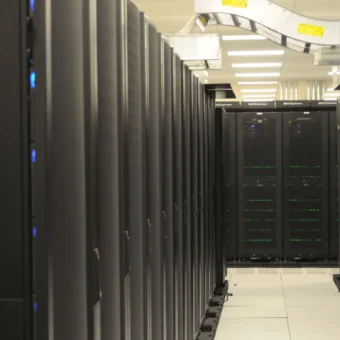
Featured image: A NASA computer server farm, public domain NASA image via Wikimedia Commons. Image cropped and converted to WebP for sxz.io.





No Comment! Be the first one.