







Groq’s $350 Million Raise Cements Its Pivot From Nvidia Rival to Nvidia Customer
Groq raised $350 million at a $3.5 billion valuation to expand its Nvidia-powered neocloud, eight months after Nvidia licensed its chip technology and hired away the founder who built it to compete...
Groq raised $350 million in a new Series A round announced Monday, valuing the AI infrastructure company at $3.5 billion as it completes a pivot from building chips designed to beat Nvidia to operating a cloud business that runs on Nvidia’s own hardware. The round was led by investment firm Disruptive, with planned participation from Nvidia itself, according to TechCrunch.
Table Of Content
The new capital arrives eight months after Nvidia effectively dismantled Groq’s chip business by licensing its technology and hiring away the executives who built it. It is the second nine-figure round Groq has raised this year to fund its transformation into what the industry calls a “neocloud”: a cloud provider built specifically to run AI workloads rather than general-purpose computing.
How Nvidia Ended Groq’s Chip Ambitions
Groq spent a decade building its own silicon, a chip it called the LPU, short for language processing unit, designed to run AI inference (the step where an already-trained model answers a live query) faster and more efficiently than Nvidia’s general-purpose GPUs. The company was founded in 2016 by Jonathan Ross, an engineer who had previously helped create Google’s Tensor Processing Unit, alongside fellow Google alum Doug Wightman.
That competition ended in December 2025. Nvidia signed a non-exclusive licensing agreement for Groq’s inference technology, worth roughly $20 billion, and hired away Ross along with Groq president Sunny Madra and other staff, according to TechCrunch’s reporting on the deal. TechCrunch has described arrangements like this one, where a larger company pays a licensing fee that flows through to a startup’s investors while absorbing its key engineers, as a “not-acqui-hire”: it delivers much of the outcome of an acquisition without the deal itself being structured as one. Nvidia moved quickly to build on the licensed technology, unveiling its own hardware based on the design, the Groq 3 LPX inference accelerator, at its GTC conference in March 2026. That accelerator has since become one of the rack-mountable components in Nvidia’s Vera Rubin platform, sxz.io reported in July.
From Chipmaker to Nvidia’s Newest Cloud Partner
With its core engineering team gone and its chip IP now shared with the company it was built to challenge, Groq turned to the data center and cloud business that had been growing alongside its hardware efforts since a 2024 acquisition of Madra’s analytics company, Definitive Intelligence. In June, Groq raised a $650 million round, led by Disruptive and hedge fund Infinitum, to fund that shift, according to Groq’s own announcement. The company installed a new leadership team around the cloud business: CEO Adam Winter and CFO Matt Eng, joined by chief operating officer Alan Rice, previously of xAI and Meta’s data center organization, and a chief technology officer and chief product officer, Sinclair Schuller and Rakesh Malhotra, who had worked together at Apprenda, an enterprise cloud platform Schuller founded, before co-founding Nuvalence, a software engineering firm the two later sold to EY.
A Formal Certification, Five Days Before the Raise
On August 12, five days before the new funding round, Groq formalized the shift by becoming a certified NVIDIA Cloud Partner, a program that certifies a cloud operator to deploy and run Nvidia’s accelerated computing hardware to Nvidia’s own reference standards. “Becoming an NVIDIA Cloud Partner is a natural next step in our collaboration with NVIDIA,” Winter said in Groq’s announcement of the certification. “Inference is becoming the largest and most critical layer of AI, and we intend to run it better than anyone.”
A Valuation Cut That Groq Says Isn’t a Down Round
The new $350 million round values Groq at $3.5 billion, roughly half the $6.9 billion valuation it carried after a $750 million raise last September, before the Nvidia deal. A company spokesperson told TechCrunch that Groq does not consider the drop a down round, characterizing it instead as a fresh valuation for the “post-Nvidia-licensing-deal version of Groq,” a company now built around operating infrastructure rather than designing chips.
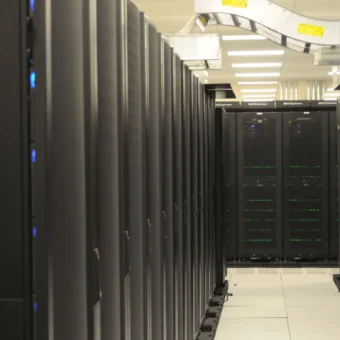
Groq says the new funds will support customers “seeking usage of medium and larger sized clusters of Nvidia accelerated computing for training and inference.” The company currently operates 13 data centers across North America, Europe, the Middle East, and Asia Pacific, serving more than 6 million developers, up from the more than 5 million it reported in June, and it plans to scale its power capacity from 54 megawatts to more than 200 megawatts by the end of 2027. “We are building Groq into the world’s leading AI inference cloud,” Alex Davis, Groq’s chairman and the chief executive of lead investor Disruptive, said in a statement reported by TechCrunch. “Inference will without a doubt become the largest and most critical layer of AI infrastructure.”
Joining a Crowded, Unproven Business
Groq’s pivot puts it in direct competition with a growing field of Nvidia-dependent neoclouds, including CoreWeave, Lambda, and Nebius, all of which buy GPUs from Nvidia while also counting Nvidia among their investors, a circular financing pattern that has become common across the AI infrastructure industry. TechCrunch noted that CoreWeave, the most prominent example, has posted strong revenue growth and landed major contracts with Meta and Anthropic, but investors remain wary of its heavy capital expenditures, reliance on debt, and exposure to hardware that depreciates quickly, along with open questions about whether that growth will ever convert into free cash flow.
Groq’s own financials remain private, so it isn’t yet possible to independently assess how the neocloud business is performing relative to the chip business it replaced. What is public is the scale of the bet: two funding rounds totaling $1 billion in under two months, a full leadership turnover, and a formal certification tying the company’s future to the same GPU maker it spent a decade trying to outrun.


No Comment! Be the first one.